Use CoPlanAI · five ways to work together

From one workshop to how your institution decides.

Start with the platform and your own facilitators, or go as far as changing your institution’s own processes. Each way below says who it suits, what it involves and how long it takes.

Our work since 202195 engagements73 cities38 countries

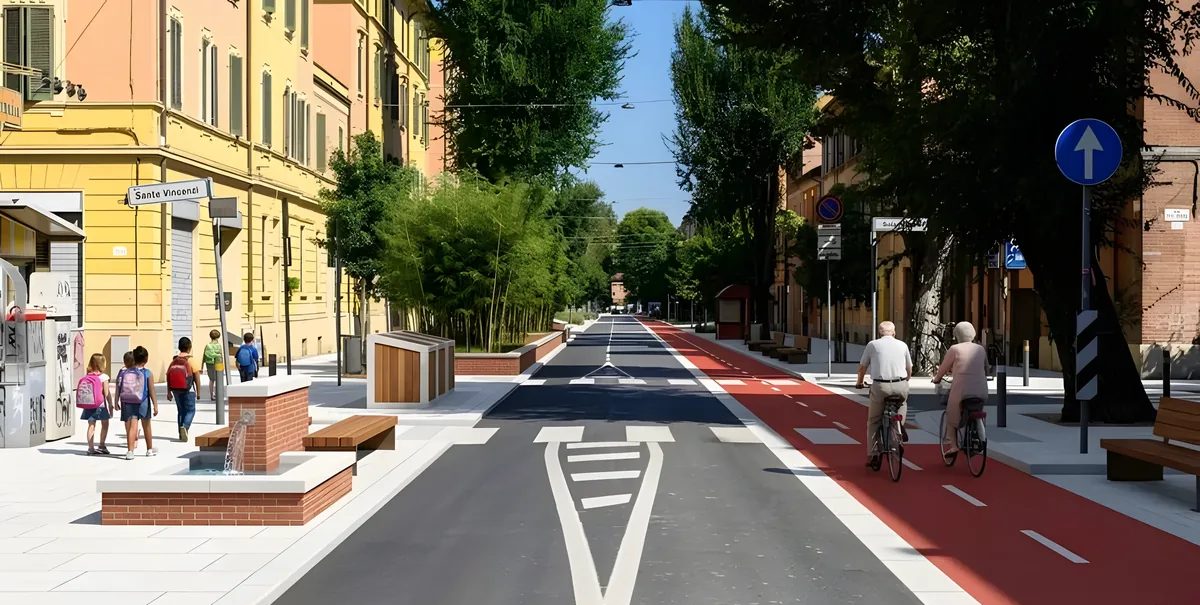
A Bologna street as photographed: a wide carriageway, parked cars and a pedestrian crossing. The same street as a scenario from the workshop: a red cycle lane, benches and planting.

From a real street to a shared plan

Try it on the real street, before anyone commits to it.

An image puts an idea on the place itself, where everyone in the room can compare it with what is there today. Most of us only know what we want once we see it.

Bologna · 2026The street as photographed, and one scenario proposed in the workshop: a red cycle lane, benches and planting. Drag the line, or use the arrow keys, to compare.

The Bologna project (opens in a new tab)

Five ways to work together

Each step up asks more of both sides.

At the first step, your facilitators use the platform on their own. At the fourth, collaborative planning becomes standard practice across the institution. At the fifth, your staff train others to run it. Durations are typical. Choose a step to see its plan.

  1. Step 1 Subscriber Self-service Platform access. Your own facilitators run the workshops. 1–2 daysto activation
  2. Step 2 Capacity Builder Guided launch A bootcamp, training in the platform and in facilitation, and a first workshop set up with you. Then you run it yourselves. 4–6 weeksto independence
  3. Step 3 Innovation Partner Co-creation A programme built around your question: the method and a tailored instance, with monitoring and evaluation. 2–4 monthsprogramme
  4. Step 4 Governance Transformation Strategic partnership Change how your institution decides: its processes, governance model and culture, with collaborative planning built in. 3–12 monthspartnership
  5. Step 5 Multiplier Programme Train the trainers Your staff become certified facilitators who onboard partner organisations, municipalities or grantees. 2–3 monthsto first rollout

Step 1 · Self-service

Subscriber

A subscription to the platform. Your team runs its own collaborative planning workshops, when it needs them.

Who it is for
Planning teams, agencies, studios and universities that have their own facilitators and want to run the workshops themselves.
What you get
  • The whole platform: scenarios, evaluation and deliberation in one place.
  • Workshops on your own schedule, as many as you need on your subscribed site.
  • A record of every project: what was proposed, how it was evaluated and what people chose, ready to export.
  • Facilitator templates and guides, so a first-time facilitator can run a session alone.
  • Support and product updates for the length of your subscription.
In use with
  • Humankind, Rotterdam 2024
  • University of Milan 2024

How it works1–2 daysto activation

Day by day
  1. Day 1JointSubscribe and accessPlan chosen, workspace created, credentials issued.
  2. Day 1–2Your teamConfigure your environmentSite photos, scenario and evaluation settings, prompts, participant interface.
  3. OngoingYour teamRun workshops independentlyAs many sessions as your plan allows, on your own timeline.

Plans and pricingEach subscription is scoped to what your team needs. Tell us, and we will send you a plan and a price.

Step 2 · Guided launch

Capacity Builder

We train your own team to run CoPlanAI, from the first set-up to the debrief.

Who it is for
Cities and public bodies that want their own staff to run collaborative planning, instead of buying it in each time.
What you get
  • Hands-on training for your facilitators, planners and communications staff.
  • A playbook tailored to your context, your mandate and your languages.
  • Your sites and workshops set up and configured with you on the platform.
  • A way to train new staff as your team changes.
  • A direct support line through your first live engagements.

How it works4–6 weeksto independence

Week by week
  1. Week 1JointDiscovery and alignmentGoals, stakeholders, and the scope of your first workshop.
  2. Week 2We leadBootcampCases from our record; your team picks a model to follow.
  3. Week 2–3We leadPlatform and facilitation trainingScenario and evaluation settings, prompts, participant setup, facilitation technique.
  4. Week 3–4We leadFirst workshop set-upWe build your first session from your site materials.
  5. Week 4–5JointSupported first engagementYour facilitators run it; we support them live.
  6. Week 5–6JointDebrief and handoverWhat worked, what to refine. Then you run it on your own.

Step 3 · Co-creation

Innovation Partner

We develop new methods and research with you, often inside funded research and innovation projects.

Who it is for
Research consortia, funded programmes, universities and cities that want to test something new in collaborative planning.
The programme
Built around your question: the method, a tailored instance with its own interface and purpose-built AI, and monitoring and evaluation from start to end.
What you get
  • Joint method design, around your research questions.
  • New platform capabilities prototyped around your pilots.
  • A partner who can co-write and co-deliver funded work packages.
  • Shared results: publications and open outputs, where they fit.

How it works2–4 monthsprogramme

Week by week
  1. Week 1–2JointScopingWhat you want to achieve, and whether a new model is needed.
  2. Week 2–3We leadLandscape reviewPrecedents and current practice, reviewed together.
  3. Week 3–5JointCo-design bootcampWe shape the participation framework and session flow together.
  4. Week 5–8We leadCustom platform developmentA tailored interface and flows, and purpose-built AI for scenarios and evaluation.
  5. Week 7–9JointFacilitator training and rehearsalTraining, and a dry run of the new format.
  6. Week 9–12JointLaunch and supported deploymentThe first cycle runs live with our team alongside.
  7. Week 12–16JointMonitoring and refinementOutcomes analysed, method refined, ownership transferred.

Step 4 · Strategic partnership

Governance Transformation

Collaborative planning leaves the one-off workshop and becomes part of how the institution works, across the departments that shape a place.

Who it is for
Governments, cities and international organisations whose leaders want public imagination to be a standing part of how decisions are made.
What is redesigned
The institution’s internal processes, its governance model and its culture, around collaborative planning with AI.
What changes
  • Where the public enters. People come in earlier, while the options are still open.
  • Your statutory and consultation moments, with collaborative planning built into them.
  • Work across departments. Teams inside the institution work on the same scenarios and evaluations as the public.
  • Governance, data and accountability that stand up to public scrutiny.
  • A long-term partnership while the practice becomes standard.

How it works3–12 monthspartnership

Month by month
  1. Month 1JointInstitutional diagnosticA joint review of how you involve people today, inside the institution and outside it.
  2. Month 1–2JointOpportunity mappingThe decisions where collaborative planning with AI should enter first.
  3. Month 2–3JointTechnology bootcampStaff test the tools and adapt them to their own work.
  4. Month 3–4JointNew process co-designA blueprint for the new way of working.
  5. Month 4–6We leadCustom platform buildA dedicated instance built to put the blueprint to work.
  6. Month 5–7JointStaff training and pilotingTraining plus pilots that test the redesign in real conditions.
  7. Month 6–10JointScaled deployment and iterationRollout across the organisation, with us alongside as advisers.
  8. Month 10–12JointEvaluation and handoverImpact measured; you take full ownership.

What it can take

The partnership runs for 3 to 12 months. The change around it can take longer. In Dubai it took three years, in five steps, and the mandate came before the pilot.

  1. 01Exploration
  2. 02Outreach
  3. 03A mandate
  4. 04A pilot
  5. 05Integration

Step 5 · Train the trainers

Multiplier Programme

We train the trainers. Your staff become certified facilitators, who then onboard partner organisations, municipalities or grantees.

Who it is for
Organisations that work through others, such as development agencies, networks of municipalities and grant programmes, and teaching institutions that train planners.
What you get
  • Training and certification for your staff as facilitators.
  • A rollout plan for the organisations they will onboard.
  • Our support until the first rollout.

How it works2–3 monthsto first rollout

We plan each programme with the organisation that runs it.

Beyond the plans

Custom builds and white-label deployments, on your infrastructure.

We add features when clients ask for them, and every deployment receives them. With Innovation Partners and Governance Transformation partners we also build private, white-labelled versions of CoPlanAI, designed together and deployed on the partner’s own terms.

Write to us about a custom deployment
  1. 01

    Customised to your practice

    Workflows, languages, themes, evaluation criteria and integrations, built to your request and kept up to date as the product develops.

  2. 02

    Private and white-labelled

    Your name, your brand, your instance: a dedicated platform for your institution, as we have built for a city government. Only the institution sees it.

  3. 03

    Your servers, your models

    Deployed on institutional infrastructure or regional servers for data residency and compliance, running the generative models your policy prefers.

The platform

One engagement, three surfaces, one record.

The AI does two jobs. It generates scenarios from people’s own words, on the real place. And it evaluates them, against the institution’s own policy, design guides and law, and for their likely environmental and social impact. People deliberate; the institution decides.

Desktop · planning teams

CoPlan Studio

The desktop workspace where a planning team turns a written brief into checked, rendered design options.

  1. It starts with an image and your brief
  2. Twenty variations from one brief
  3. Checked against the planning documents
  4. Favourites compared at one scale
  5. Renders from stored cameras
  6. Before and after, same frame

Desktop · whoever sets the engagement up

The Configurator

Where an engagement is set up: what is asked, of whom, and what the participant’s phone will show.

  1. The four tasks, on two axes: Futuring, Scenario planning, Co-design, Design review
  2. Who takes part
  3. How much ground it covers
  4. Theme selection

Phone, tablet or kiosk · residents and stakeholders

The participant app

What a resident holds: a street, a question, and their own idea coming back as a picture, with no account at any point.

  1. In with a QR code, no account
  2. Say it in your own words
  3. Your words become a picture
  4. One picture, six seats, live
  5. Sift what everyone made
  6. Kept in your own words
  7. Your places, kept on your phone

The working screens

Behind the room, and in it.

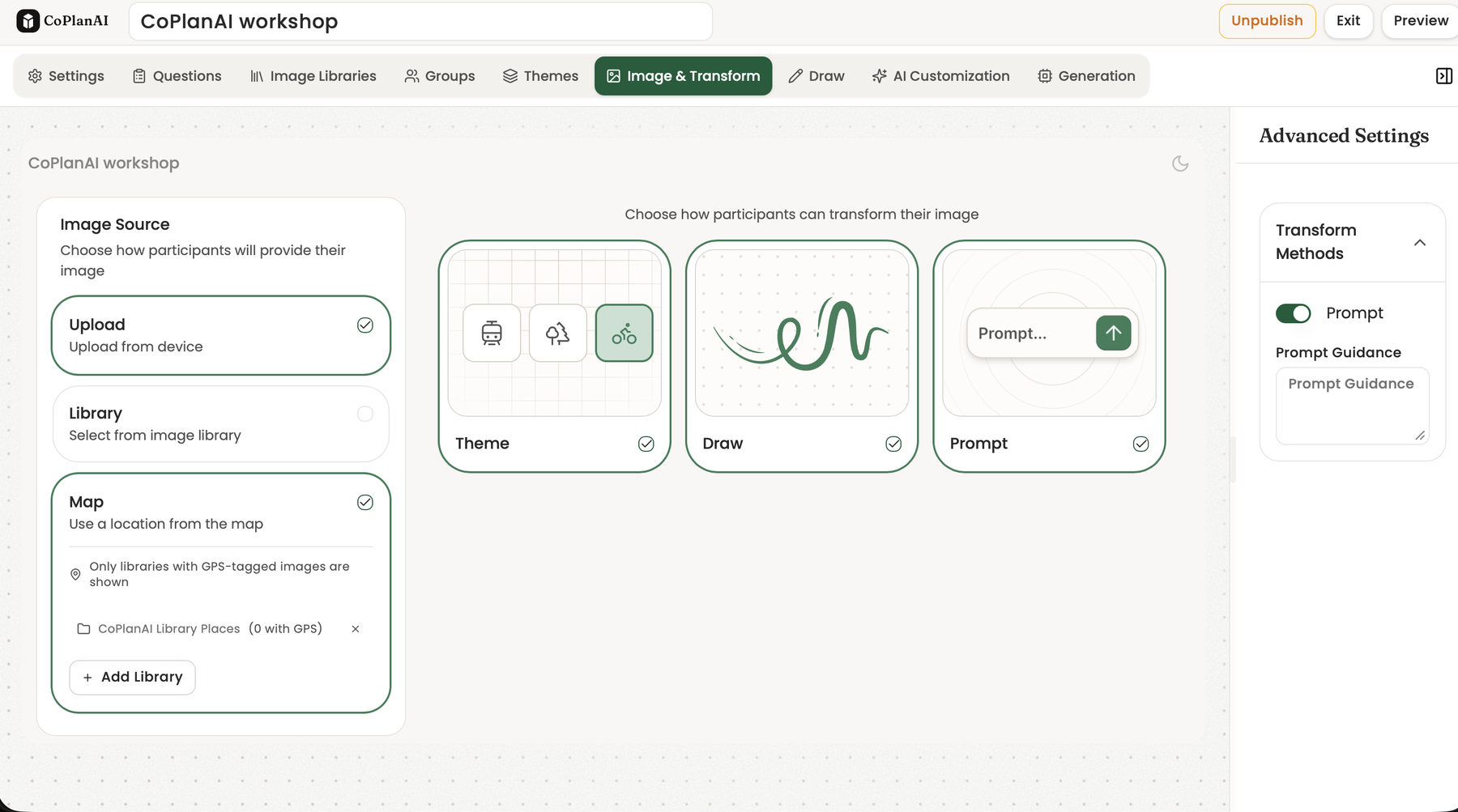
The organiser’s console, Image and Transform tab: images come from an upload, a library or a map, and people reshape them by theme, by drawing or by prompt.
Behind the room · 1 of 4Source and transformFull size (opens the screen in a new tab)

Screens from the platform, July 2026. In the room, people then compare, debate and choose, with no plans to read and no software to learn. One full loop takes about half a day.

Workshop formats

Sixteen formats, fitted to who is in the room.

Every engagement draws on one method library, grouped by who takes part. Children work with methods made for their age.

4formats

Citizens

Residents, neighbours and local businesses.

  1. 01Photo-to-scenario
  2. 02Rate and rank options
  3. 03Citizen committee
  4. 04Co-design with businesses

3formats

Children and youth

From six years old, and whole classes.

  1. 05Drawing-guided ideationages 6–9
  2. 06Tablet co-designages 10–14
  3. 07School climate futures

2formats

More-than-human

Species, habitats and the city’s ecology.

  1. 08More-than-human parametersbiodiversity, species corridors
  2. 09Museum and exhibit mode

4formats

Experts and officials

The people who must act on it.

  1. 10Policy visualisation
  2. 11Regulatory pre-evaluation
  3. 12Cross-department alignment
  4. 13Supervised professional workshop

3formats

Online

Anyone who could not come to the room.

  1. 14Online deliberation campaign
  2. 15Map-based online proposals
  3. 16Expo and kiosk mode

Safeguards

Governance, data and energy, in brief.

An institution that brings AI into planning should know how the AI is governed, where the data goes and how much energy it uses.

AI governance · limited risk

Our commitments, and yours.

We set out who does what, four commitments on how the AI is used, and how we curate the model’s bias. We ask every partner organisation to write its own commitments.

AI can imagine anything. Only a community can give it a mandate.

Ethics and AI governance

Data and compliance · Europe

Hosted in Europe. The outputs are yours.

  • GDPR compliant. Personal data is processed only where the service needs it.
  • Facial analysis: none. The platform neither collects nor analyses facial features in uploaded images.
  • You own every output. All generated content and aggregated preference data remain the client’s exclusive property.
  • Encrypted in transit and at rest, on AWS infrastructure.
  • EU AI Act, limited risk. A decision-support tool with transparency, human oversight and bias mitigation built in.
Hosting
AWS, Europe regions
Data processor
AWS, under GDPR
Frameworks
GDPR · EU-US Data Privacy Framework
Your outputs
Client property, unrestricted use
AI Act class
Limited risk
Request the full data and server sheet

Energy and footprint

Computing only while a workshop runs.

The model generates an image in seconds, then stands down. We use existing foundation models at workshop scale and train no large models of our own.

Service level

What partners can count on.

99.5% availability per month, during business hours. A critical response within 2 business hours, or 1 hour during a live workshop on standby. Daily backups. Support by email, 09:00–17:00 EET, Monday to Friday.

governance@coplanai.com

In full

Ethics, data and the company.

The people, the company and its register details, and the full ethics and compliance record.

About CoPlanAI

Where to start

What is already decided?

If your city is about to decide something, start with this question. The answer names the kind of work, what comes out of it and what to send us first.

Choose the one closest to yours

You need three things: one real question, a place or a plan, and the people. Choose an answer above, or write to info@coplanai.com.

Teaching how to plan together, at a school, a university or in a training programme? Start with the Subscriber plan or the Multiplier Programme.

info@coplanai.com