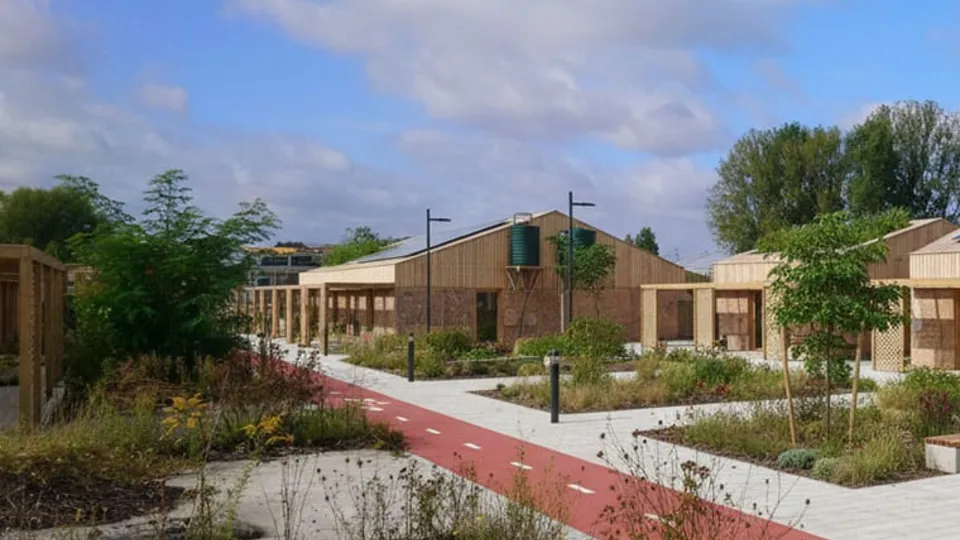
Collaborative planning · Helsinki · since 2021

The mandate to imagine.

A city with no mandate to imagine its future can only administer it.

We help cities try ideas with the people who live there while the brief is still open, and build the mandate to act on what comes out. We also run educational programmes for schools, universities and professional training.

141 engagements90 cities46 countries

We delivered some of these engagements in our previous collaboration with Toretei, under the brand name of UrbanistAI.

Coplanning: who holds what

Coplanning

Where three kinds of knowledge meet.

Participation asked experts of planning to imagine everyday life, and experts of everyday life to comment on planning documents. Coplanning reverses this: residents imagine and evaluate, and planners turn that into design.

7 parts

Point at a circle, an overlap or the centre · or tab to it

Coplanning: Stakeholders, Institutions and Foresight with AI overlap; where all three meet is Coplanning. Seven parts: three circles, three overlaps and the centre. Choose one to read what it holds, beside the diagram.

Images let us try our ideas

  1. Collaborative planning is the opportunity to evaluate ideas and scenarios,

    Vienna · Supergrätzl · 2026

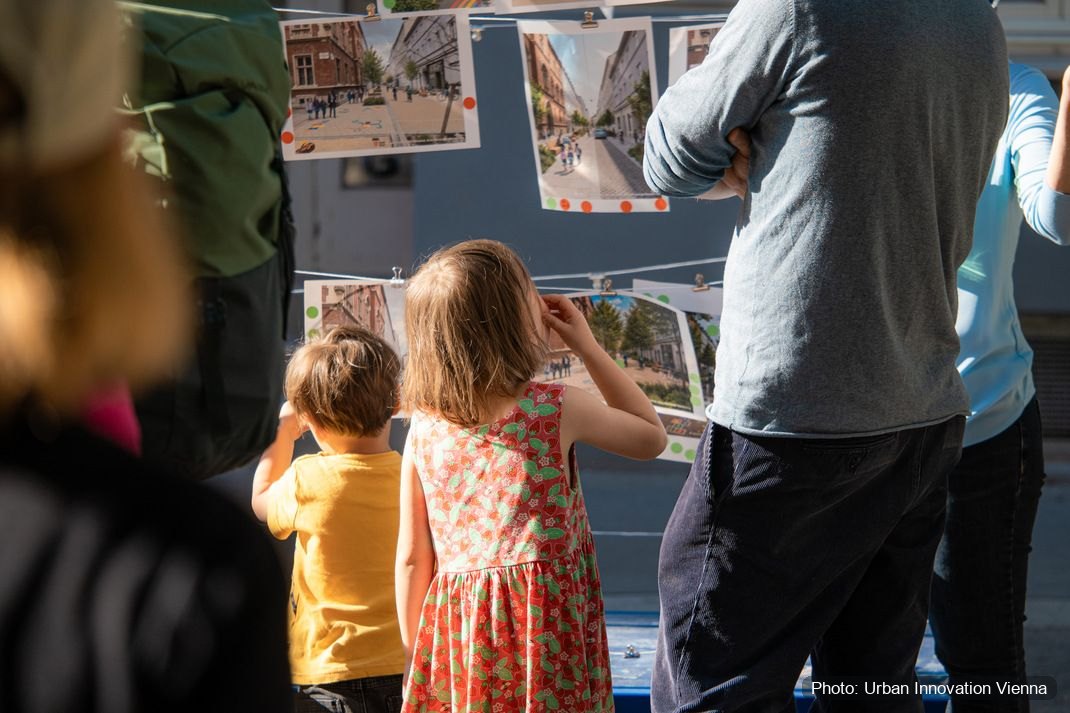
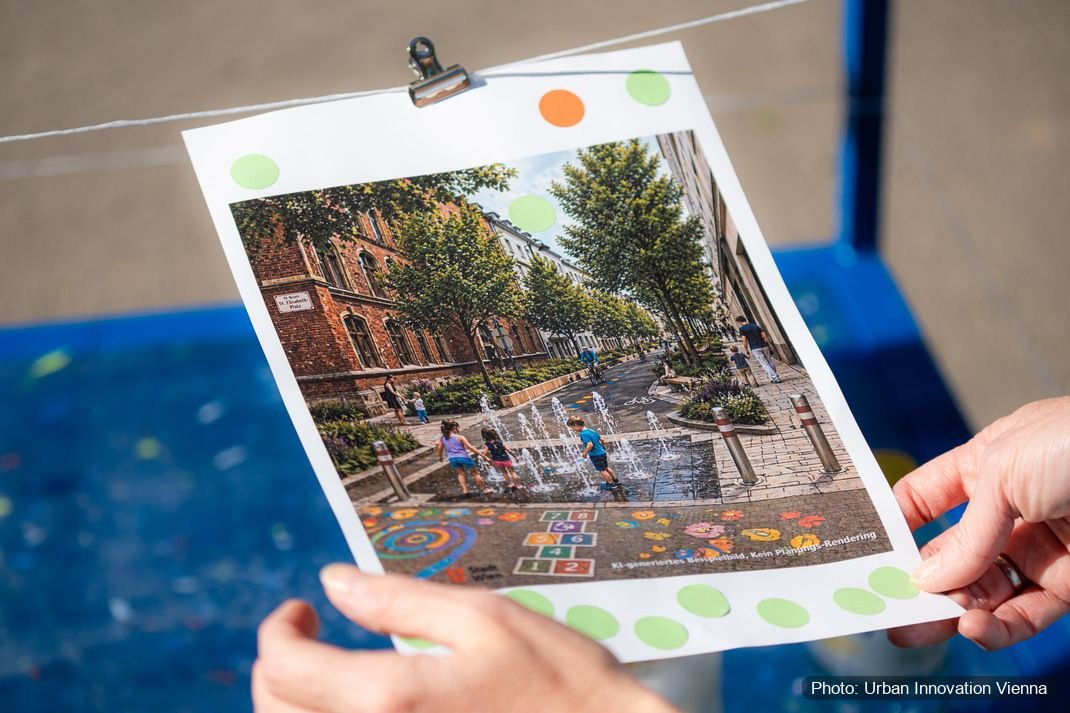
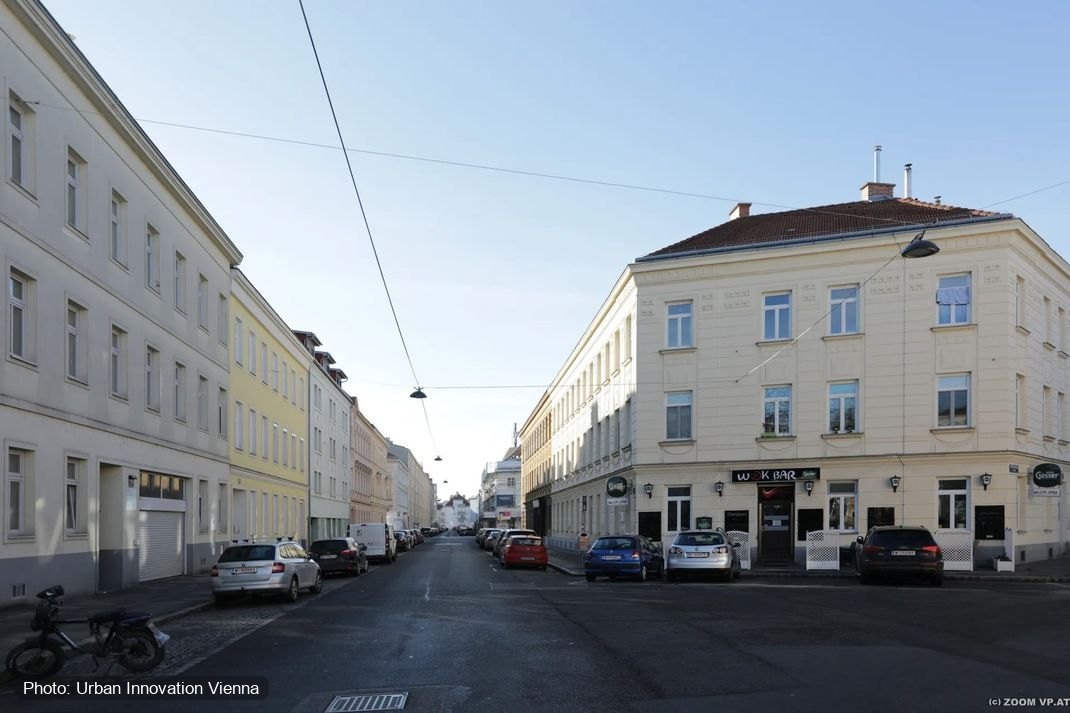
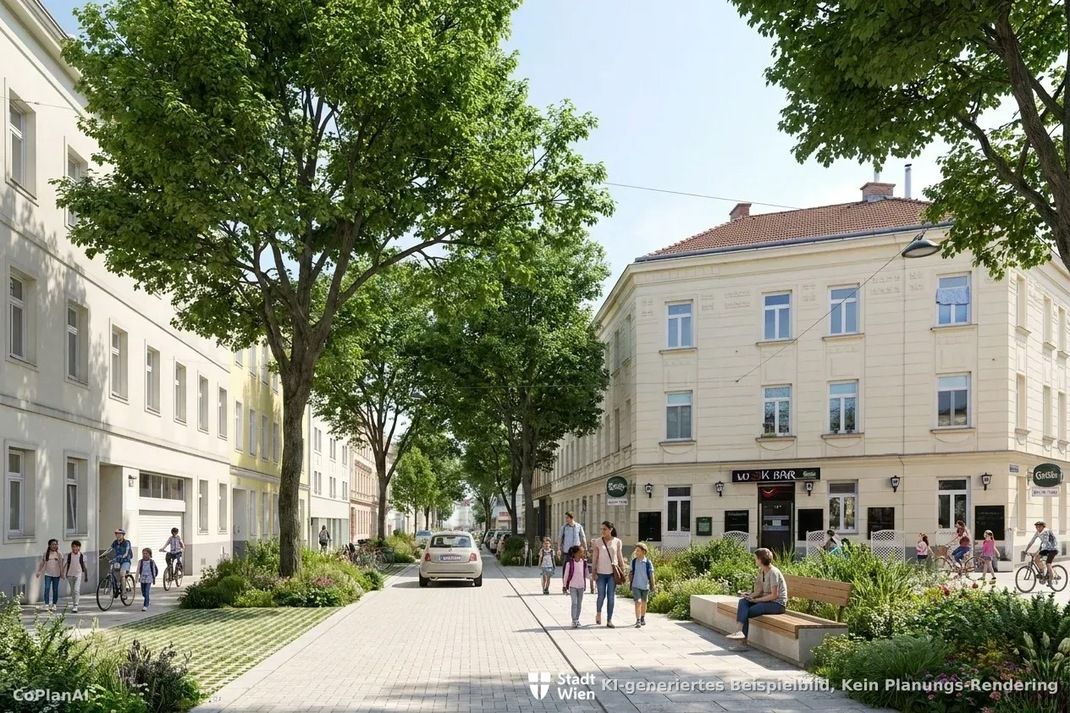
    The same street corner, as it is and as a scenario, with trees and planting where cars were parked. For the Supergrätzl, residents weighed generated images of their own streets: printed, pegged to a line and marked with dots.

    Every image carried the city’s own label: „KI-generiertes Beispielbild, kein Planungs-Rendering“, an AI-generated example image, not a planning rendering.

    A street corner in Vienna as it is: asphalt, parked cars and a corner café. The same corner as a scenario: trees, planting and benches along a paved street, people walking and cycling, and the city’s label: an AI-generated example image, not a planning rendering.
    Children and adults in the street looking up at printed scenarios pegged to a line.
    Scenarios on the line
    A hand holding a printed scenario, a street with water play and planting, marked with coloured dots.
    A choice, in dots
    Vienna Supergrätzl · drag to compare
  2. understand their impact,

    The impact evaluator · on the platform

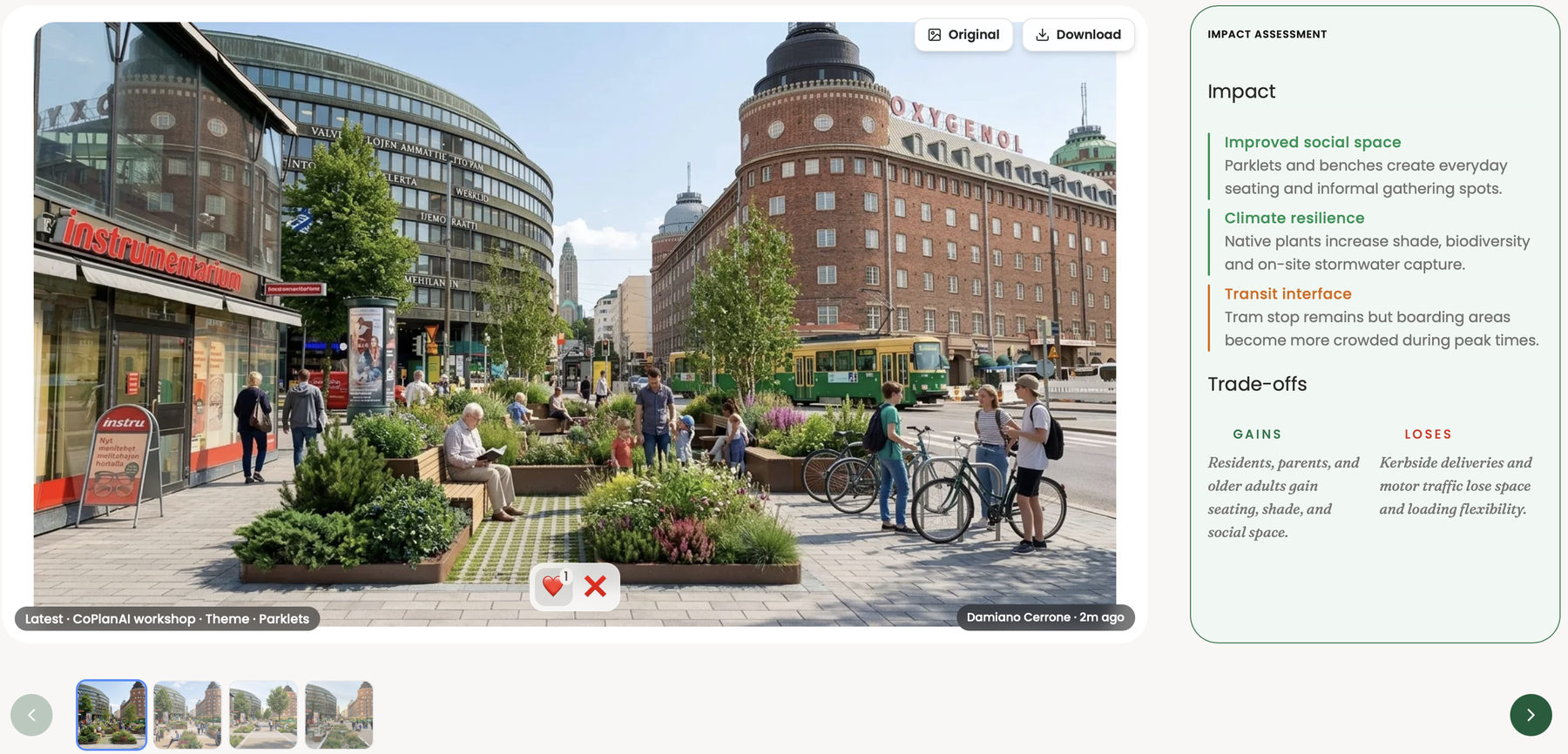
    A street corner with parklets tried on it, and beside it the evaluation: what the change would do, who gains and who loses.

    Each scenario is checked as it is made: against the institution’s own rules, and for its likely environmental and social impact. The evaluation informs the choice. People make it.

    The impact evaluator on the platform: a city-centre street corner with parklets, planting and benches tried on it, and beside it the impact assessment and its trade-offs.
    Impact
    • Improved social space. Parklets and benches make room to sit and meet.
    • Climate resilience. Native planting adds shade, biodiversity and stormwater capture.
    • Transit interface. The tram stop stays, but boarding gets more crowded at peak times.
    Trade-offs
    • Gains. Residents, parents and older adults: seating, shade, social space.
    • Loses. Kerbside deliveries and motor traffic: space and loading.
    A scenario and its evaluation, side by side
  3. take an informed decision

    Munich · Zamanand festival · 2024

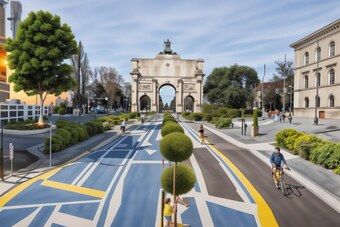
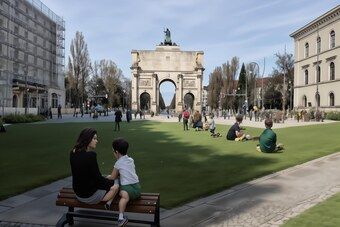
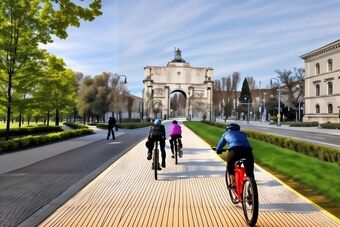
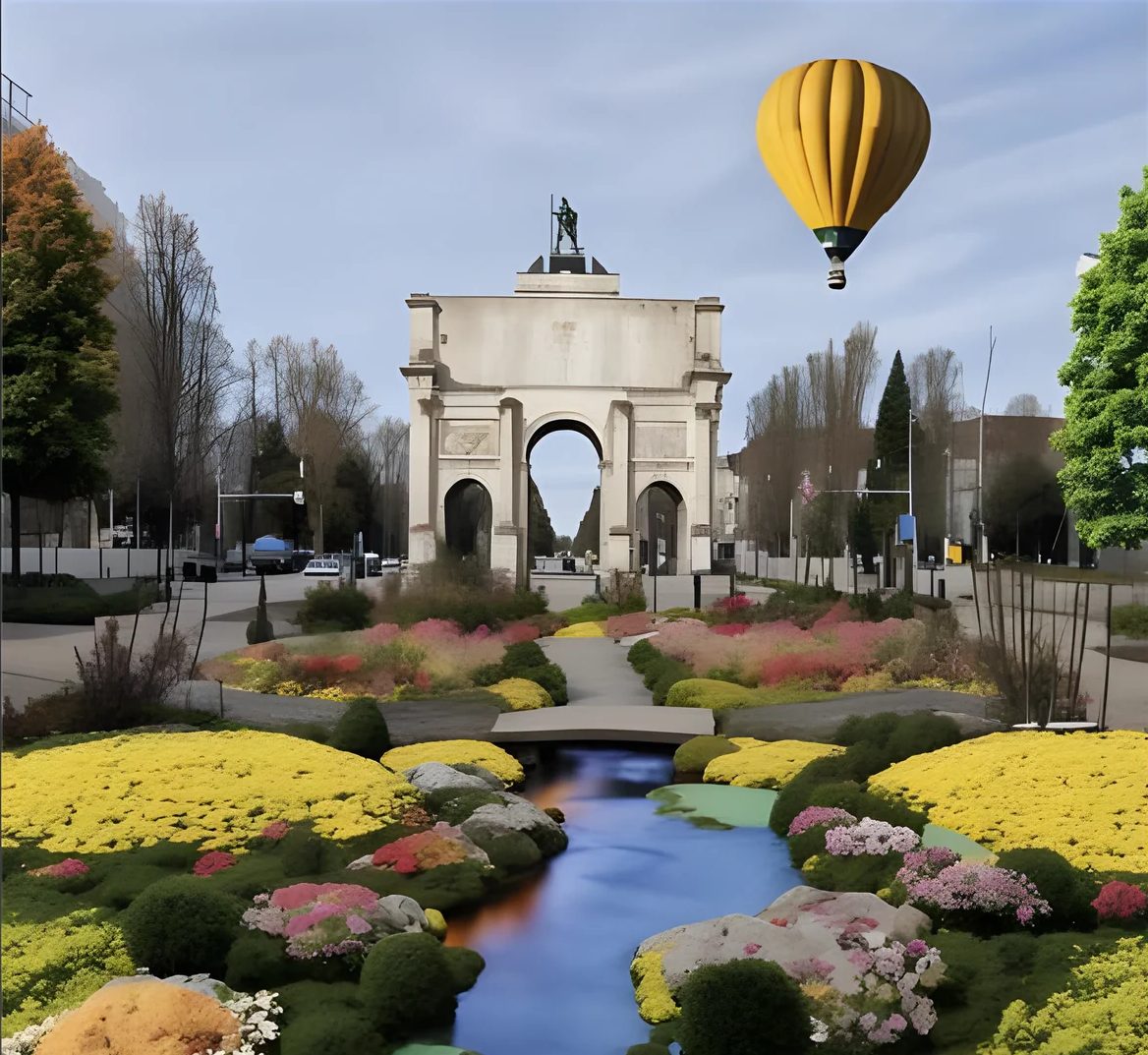
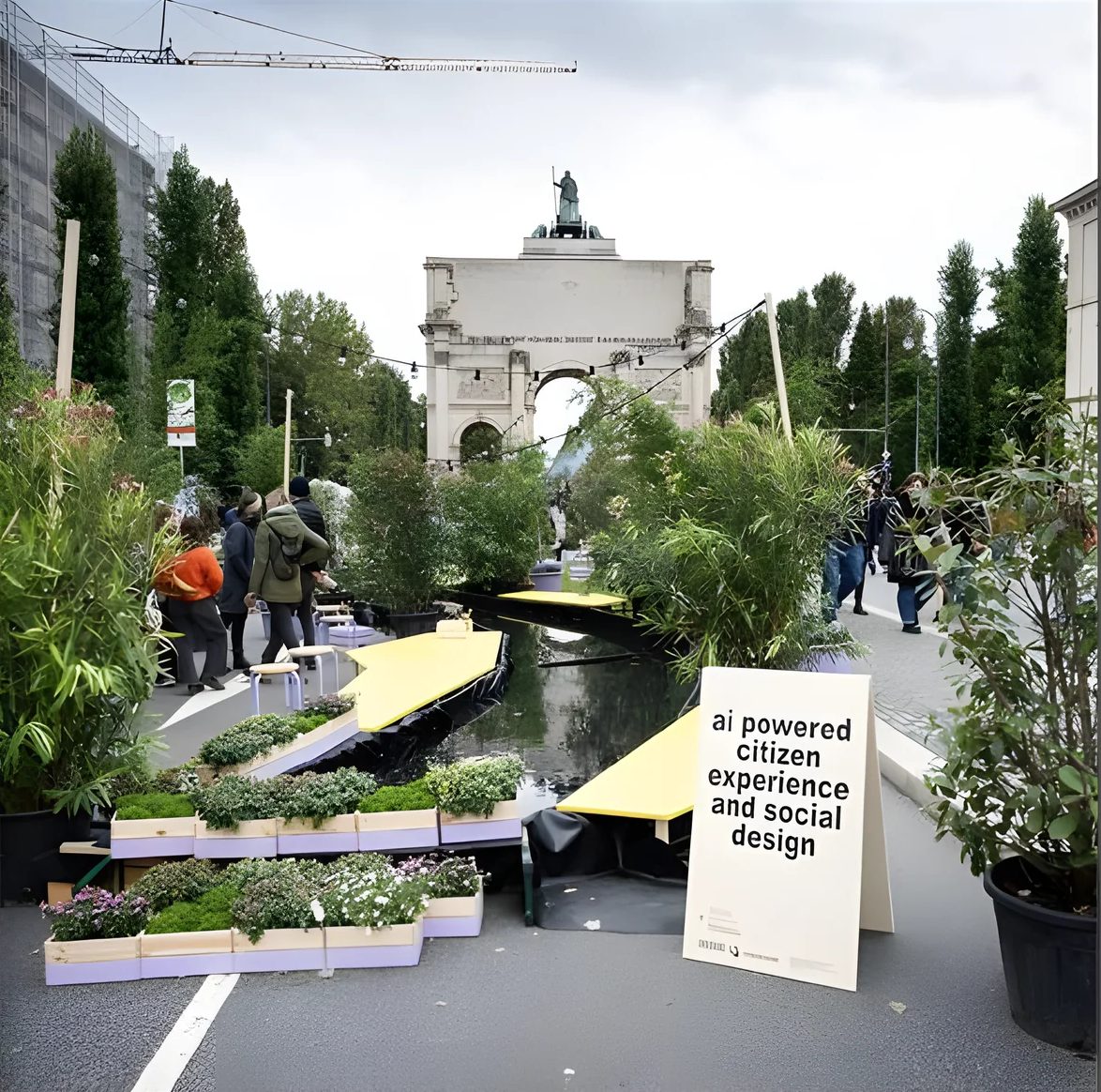
    Visitors put more than 3,000 ideas for a car-free space around the Siegestor into images; about 300 votes chose one, and it was built there as a walkable prototype four months later. A vote is as informed as what people can see when they cast it.

    Kaarina · with Sweco · 2024

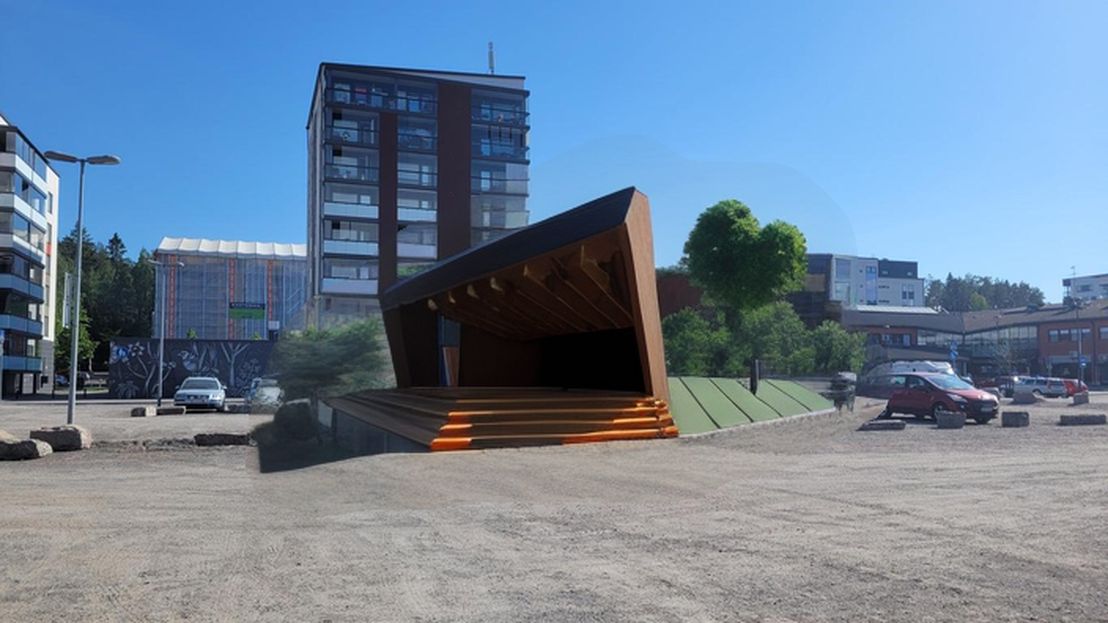
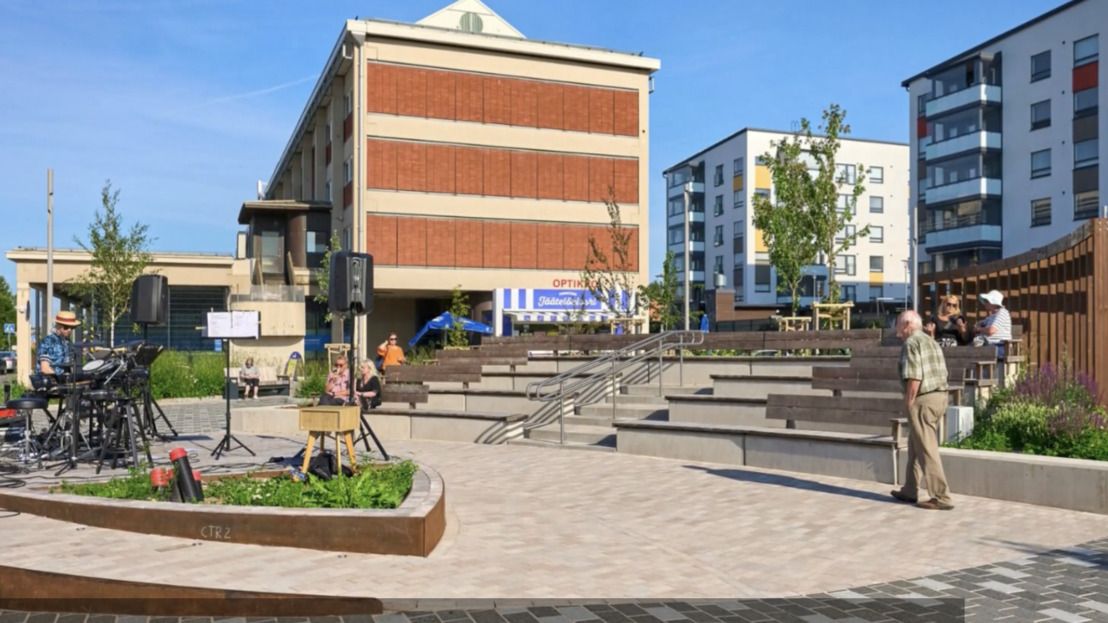
    Residents generated scenarios for the market square in a workshop and voted on 28 of them. The vision plan was approved in late 2024, and water, art and a stage were built on the square.

    Generated in the workshop: a timber stage with orange steps, standing on the square while it was still an open gravel lot.Asked in the room The stage as built on the finished square: tiered seating, planting and a band setting up.Built on the square
    Kaarina Market Square
    3,000+ideas · a few of them Idea: a brightly painted street with clipped trees. Idea: a lawn with a family on a bench. Idea: a timber path across the grass, with people cycling along it. Idea: a water channel lined with planting. Idea: a playground with slides. The winning image: the Siegestor with a stream and a flower meadow in place of the road.Chosen by about 300 votes The walkable prototype built at the Siegestor: planters, a timber deck and people walking through.Built, four months later
    Re-imagining the car-free city, Munich
  4. — and even change your choice.

    Bologna · TICO – Officina mobile della conoscenza · 2026

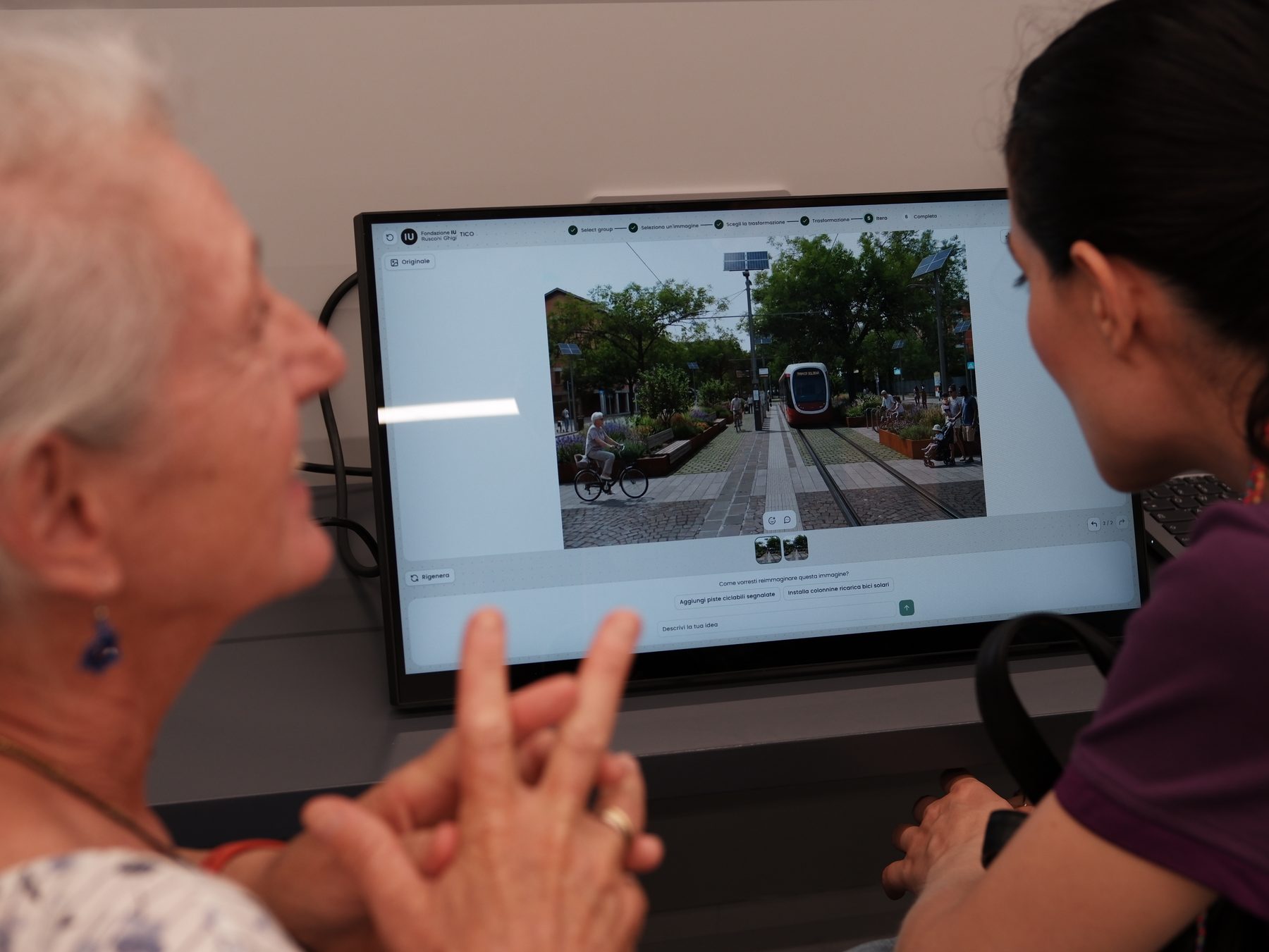
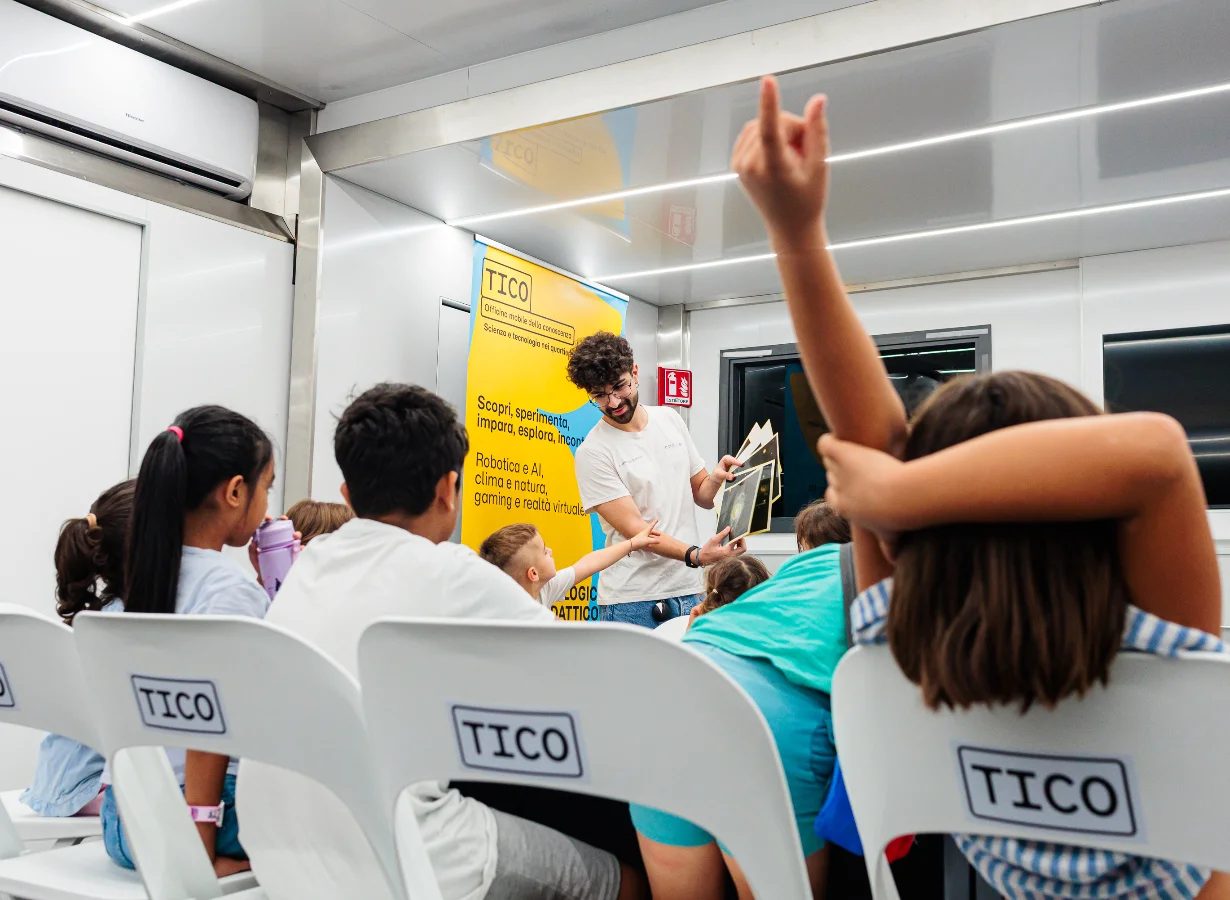
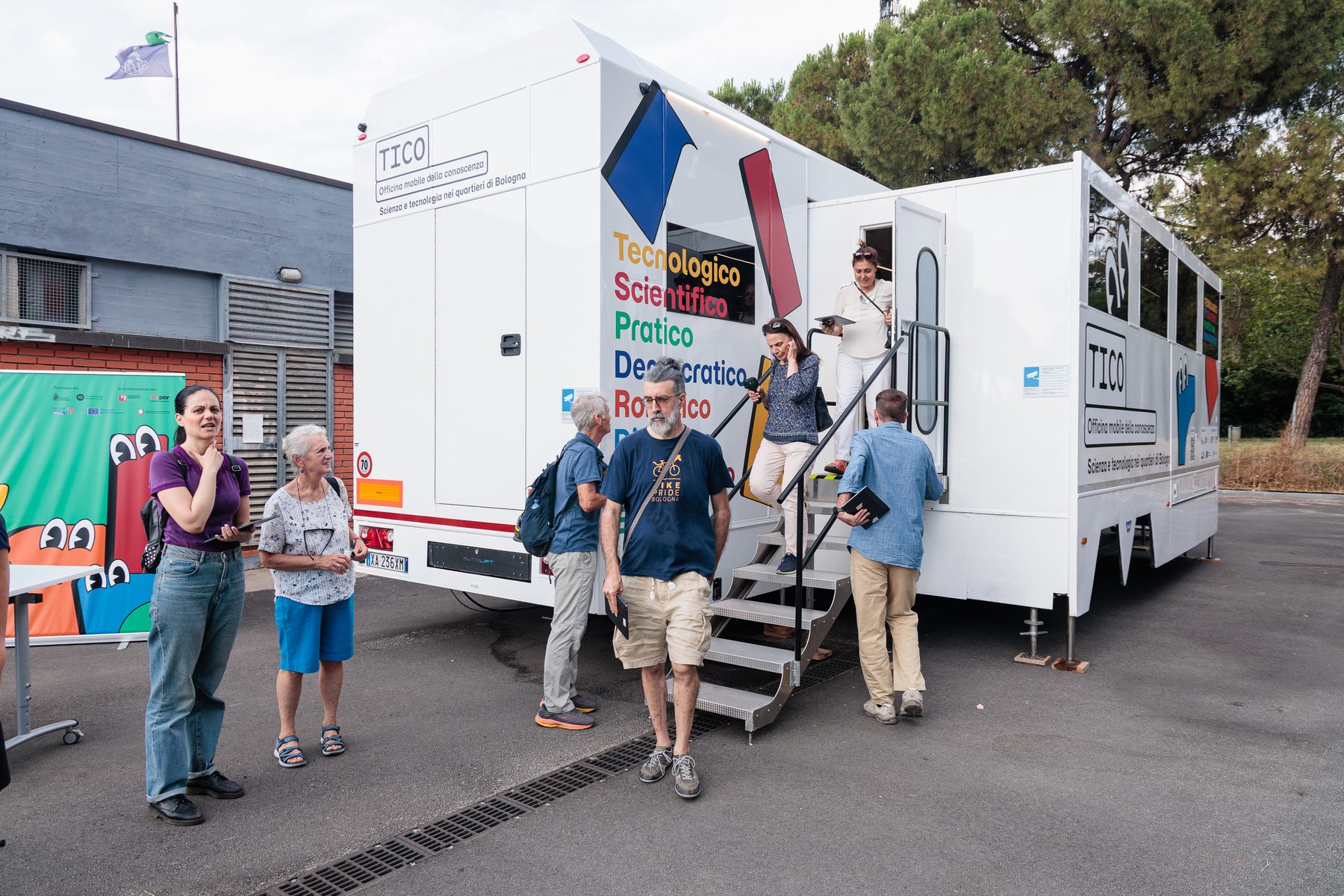
    TICO is the City of Bologna’s workshop truck. It travels through the city’s neighbourhoods, from Borgo Panigale-Reno to Savena, and ours is one station in it. Pupils, families and neighbours try an idea on a real street, see what it would change, and talk it through with whoever is standing next to them.

    Changing your mind after seeing more is part of learning. It is also part of democracy.

    Because a city is democratic when it holds knowledge in common.

    «Perché una città è democratica quando mette in comune la conoscenza.» City of Bologna, TICO page
    An older woman and a younger woman reading a street image together on the touchscreen.
    A school class on TICO chairs inside the truck, one hand raised, a screen at the front. The TICO workshop truck parked in a Bologna neighbourhood, people climbing its steps.
    TICO, Bologna

Where we have worked

Everything we know was learned somewhere.

One disc per city, sized by the number of engagements there (a project, or one session of a longer project) and coloured by the task most often run there; grey where none of them is on the framework yet. The land is drawn in dots, denser along the coasts and closest to where we have worked. Point at a city to read it. Positions are approximate. Land: Natural Earth.

See all use cases

The engagement framework · how we work

The four tasks of coplanning.

The engagement framework, built from our work Two axes, open brief to defined brief and respond to propose, make four tasks: scenario planning top left, speculative futures top right, design review bottom left, co-design bottom right. Each disc is one engagement.
The engagement framework, built from our work since 2021.

00Before the build

Two questions place every engagement.

Any engagement that asks a public something can be placed with them: a workshop, a museum kiosk, a festival vote, a truck touring the neighbourhoods.

The figure is built from our own work: each disc is one of the 78 engagements in which people were asked. Talks, trainings and research grants are left off.

01The vertical axis

Open brief, or defined brief

Could this engagement still change what will be done, or only how?

At the top, the brief is open: nothing is fixed yet, and what people say can change the plan itself. At the bottom, it is defined: what will be built is settled, and people shape how it looks and works. Each end promises something different, and a city should know which one it is offering before it asks.

From our vocabulary

open brief

What will be done is not yet decided, so an engagement can still change what happens, not only how.

defined brief

What will be done is already decided. An engagement can still change how it is done, but not whether.

02The horizontal axis

Respond, or propose

Will people bring material you do not have yet, or respond to material you provide?

On the left, people respond: to a scenario, a policy idea, a drawing someone else made. On the right, people propose: they bring the photograph, the wish, the first image of what could be there. Where the two questions cross, four tasks appear.

From our vocabulary

respond

People respond to material we provide: a scenario, a drawing, a policy idea.

propose

People bring material we do not have yet: a wish, an idea, a photograph of their own street.

03Open brief · respond

Scenario planning

What if this happened here?

Already decided

The question, not the answer. We have options to put to people.

A scenario or a policy idea goes to people before anything is decided, and we learn what they could live with.

In Enschede, residents of Twekkelerveld added trees, benches and water to photographs of their own streets. At the Estonian Museum of Natural History, a kiosk with no facilitator let visitors try a more biodiverse city on real sites. TICO in Bologna, above, sits here too.

    04Open brief · propose

    Speculative Futures

    What could this place become?

    Already decided

    Nothing yet. We want ideas about what this place could become.

    Everything is still open. People bring the future they want for a place, and it becomes the raw material of the brief.

    In Lahti, 66 images made by residents and stakeholders at an open-house station fed the City Centre Vision 2040, which the city adopted in spring 2024. In Luleå, children photographed real places and reimagined them on their own terms.

      05Defined brief · respond

      Design review

      What would make this better?

      Already decided

      The design. We want it better before it is final.

      The design exists. People react to the actual drawings while there is still time to revise.

      Vienna’s Supergrätzl and Munich’s Siegestor, both above, sit here. So do Helsinki’s market squares and Liivalaia Street in Tallinn.

        06Defined brief · propose

        Co-design

        How should it look and work?

        Already decided

        What we will build, but not yet how it looks.

        What will happen is decided: a street, a square, a building. How it takes shape is open, and what people propose feeds the design.

        Helsinki Summer Streets, 2023, sits here. So do Kaarina’s market square, above, and Jyväskylä, where culture and real-estate actors imagined new uses for the interiors of the main library.

          That is the whole framework: 78 engagements, four tasks, two questions. The use cases page holds every one of them, with a filter for each task.
          Working with us

          Five ways to work together. Each step up asks more of both sides.

          Choose by what you want to change. The durations are typical.

          1. Step 1

            Subscriber

            Self-service

            You bring the facilitators; we provide the platform.

            What changesYour tools1–2 daysto activation

          2. Step 2

            Capacity Builder

            Guided launch

            A bootcamp from the case library, training on the platform and in facilitation, and a first workshop set up with you. Then your team carries on independently.

            What changesYour team’s skills4–6 weeksguided

          3. Step 3

            Innovation Partner

            Co-creation

            A programme built around your question: the method, a tailored instance, custom interface and purpose-built AI, with monitoring and evaluation.

            What changesThe method itself2–4 monthsprogramme

          4. Step 4

            Governance Transformation

            Strategic partnership

            Internal processes, governance models and institutional culture, redesigned around collaborative planning. For governments and international organisations.

            What changesThe institution3–12 monthspartnership

          5. Step 5

            Multiplier Programme

            Train the trainers

            Your staff become certified facilitators, who then onboard partner organisations, municipalities or grantees.

            What changesWho else can run it2–3 monthsto first rollout

          Ways to work together, and the platform