Use · swipe on mobile
1 / 16
CoPlanAI · the mandate to imagine

The mandate
to imagine.

Shifting from participation to collaboration — inside a city’s own planning and innovation teams, and with the people who live there. CoPlanAI is the link that lets those two worlds talk, so transformation arrives sooner, and stays affordable.

A slide walk-throughA SPIN Unit platformHelsinki
Use or swipe
1The starting point

Cities are asked to deliver the future — but rarely allowed to imagine it.

The biggest constraint in urban transformation isn’t technical. It’s institutional: cities are handed ever-larger mandates to act on the future, and almost none to picture it first.

mandate to delivermandate to imagine — flat20132023
2The pressure

Cities have to change fast — the pressure has never been higher.

Climate adaptation, social cohesion, economic resilience — met with a decade of stacking frameworks, from the Paris Agreement to the EU Green Deal. Cities have answered at a scale that didn’t exist ten years ago, and participation itself is now a legal duty across Europe.

01020301k2k3k4k5k2013: 20 national adaptation strategies202014: 21 national adaptation strategies212015: 23 national adaptation strategies232016: 25 national adaptation strategies252017: 27 national adaptation strategies272018: 28 national adaptation strategies282019: 30 national adaptation strategies302020: 31 national adaptation strategies312021: 32 national adaptation strategies322022: 32 national adaptation strategies322023: 32 national adaptation strategies2013: 0 Covenant of Mayors signatories2014: 123 Covenant of Mayors signatories2015: 187 Covenant of Mayors signatories2016: 828 Covenant of Mayors signatories2017: 1,195 Covenant of Mayors signatories2018: 1,659 Covenant of Mayors signatories2019: 2,329 Covenant of Mayors signatories2020: 2,945 Covenant of Mayors signatories2021: 3,753 Covenant of Mayors signatories2022: 4,437 Covenant of Mayors signatories2023: 4,519 Covenant of Mayors signatories4,51920132014201520162017201820192020202120222023
National adaptation strategies (0–35)Covenant of Mayors signatories on adaptation (0–5,000)

A decade of escalating commitments, 2013–2023. National adaptation strategies rose from 20 to 32; Covenant of Mayors signatories from zero to over 4,500. The mandate to deliver the future keeps growing; the mandate to imagine it does not. · Source: European Environment Agency.

3Why it’s hard

Yet the room to imagine — and to act together — keeps shrinking.

Three institutional fractures block the very change cities are asked to deliver.

Fracture 01

No mandate to imagine

Planning law is built to administer — zone, permit, archive — never to picture and choose between futures. Participation arrives late and narrow.

Fracture 02

No capacity to match the urgency

Overloaded, rule-bound offices and thinning planner numbers leave no room to think forward.

Fracture 03

A fraying common ground

Algorithmic silos and eroding trust outside; departmental silos and tightening budgets within.

A mandate that is missing, an urgency that is mounting, a unity that is fraying. This is the gap CoPlanAI is built for.

4The demand

What cities ask for — and what we build instead.

Requests reach us in the language of automation. Underneath each is a better use case — the one we actually deliver.

Hover or tap each card — what they ask → what we build
5Definition

What CoPlanAI is — and is not.

What it is

  • A participatory-planning platform — it structures how many people propose, compare, deliberate and converge on futures for a real place, in the room and online.
  • A shared visual language — a resident’s phrase becomes an image in seconds, so expertise is no longer the price of entry.
  • A way to produce a mandate — documented evidence of what a community can agree to want.

What it is not

  • Not an urban-design tool. No masterplans, no CAD, no technical drawings. The images are scenarios to think with — indicative, never construction-ready.
  • Not a render service. If the decision is already made, we’re the wrong tool.
  • Not automation of the public. AI never holds the pen alone; every generative step is wrapped in a human step.
If you keep one distinction

CoPlanAI produces mandates, not masterplans. The masterplan stays your job — now with evidence of what people actually want behind it.

6The method

From a photo to a built street.

No survey, no zoning map, no jargon at the entrance. One loop — sense, decide, act — shown here in Helsinki Summer Streets, with the City of Helsinki.
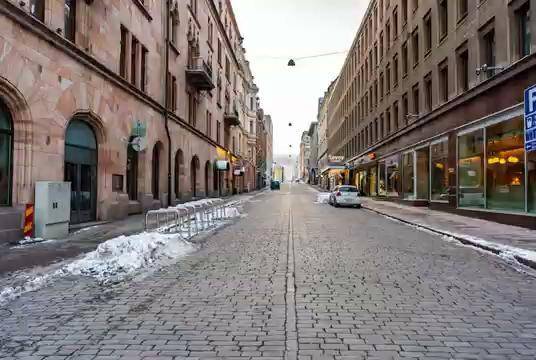
1A street in winter, Helsinki, January 2023
Jan 2023 · Sense
Start from a real photo

A photo of a real street — the only input citizens need to start.
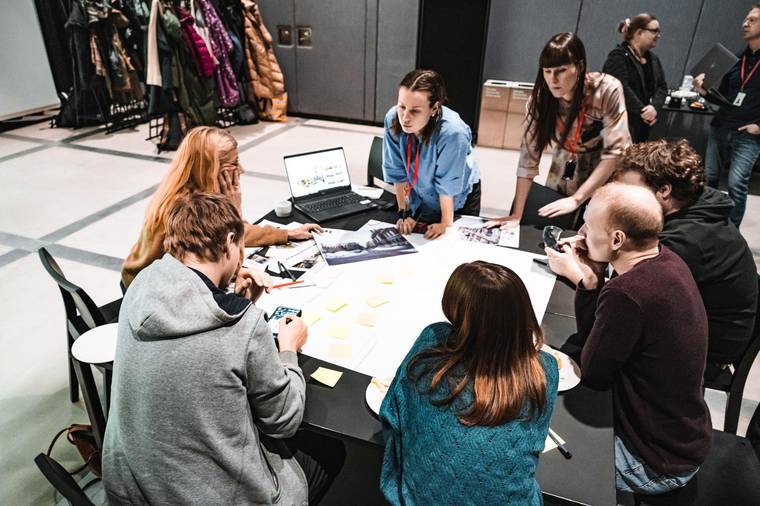
2Citizens and planners co-designing around a table in a CoPlanAI workshop
Workshop · Decide
Generate, debate, vote

A citizen committee and entrepreneurs generate, debate and vote on scenarios together.
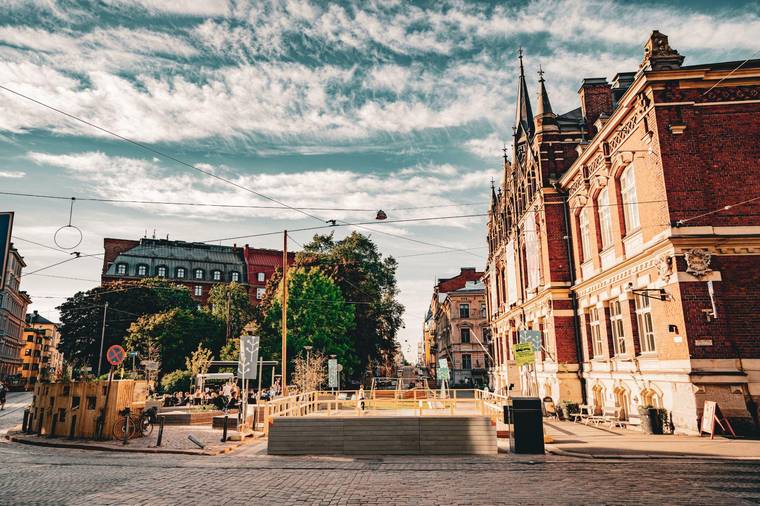
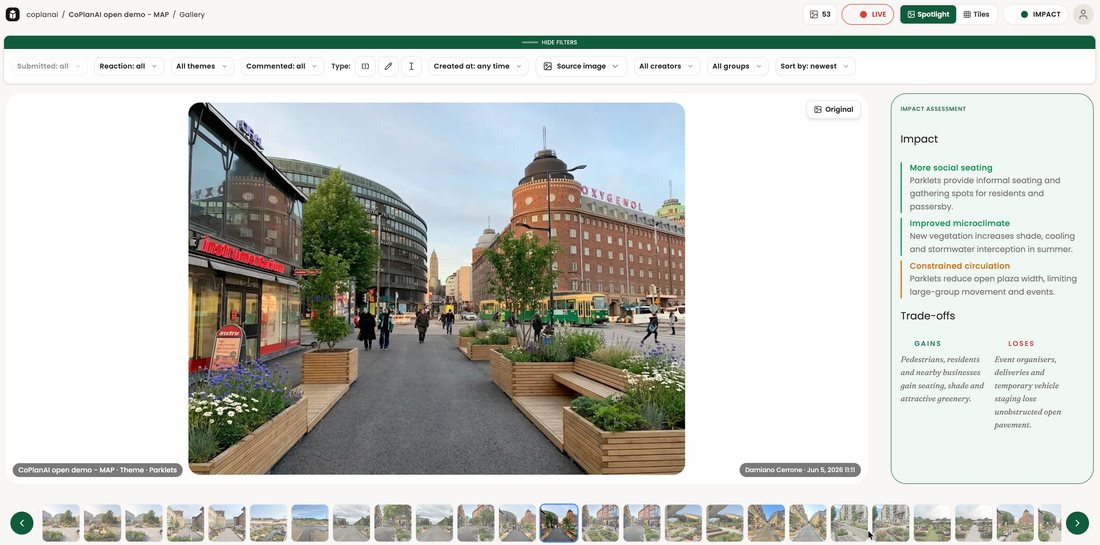
3The built Helsinki summer street with parklets and greenery, June 2023
Jun 2023 · Act
The street as built

Helsinki Summer Streets, delivered — the loop closed on the real street.

7Why it matters

The ballot box is the wrong template for design.

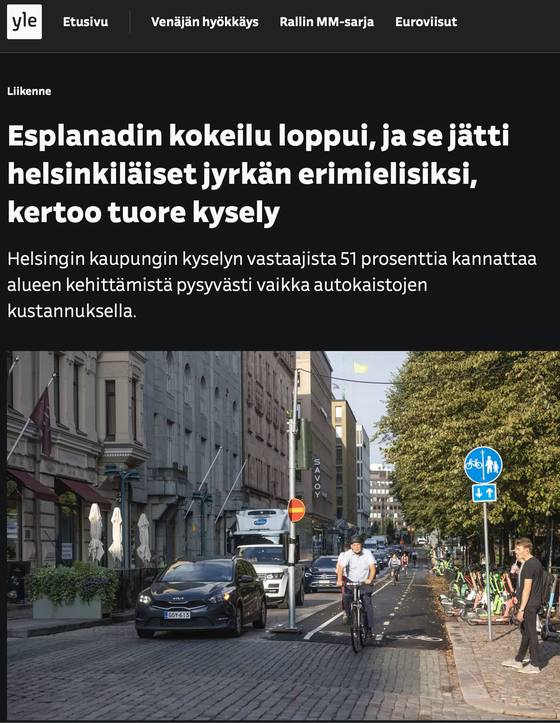
You choose once, blind, and live with it. Take a different Helsinki street — the Esplanadi cycle-lane experiment: we’ve all seen the same sequence play out — participation, then discontent, then demolition.
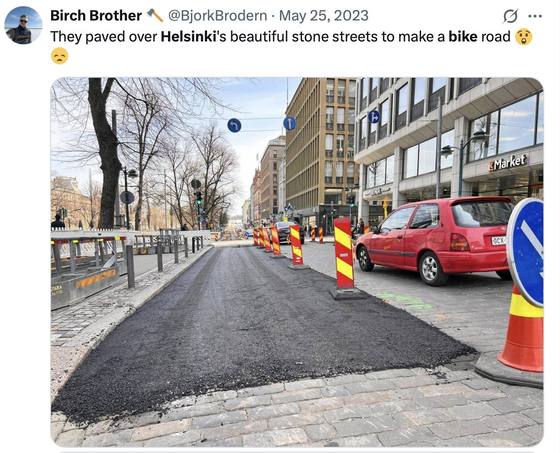
A resident posts about the Esplanadi being paved over for a bike road
Participation
The experiment is launched and consulted on.
News: the experiment ended and left residents sharply divided, a survey reports
Discontent
A survey finds residents sharply divided once it is built.
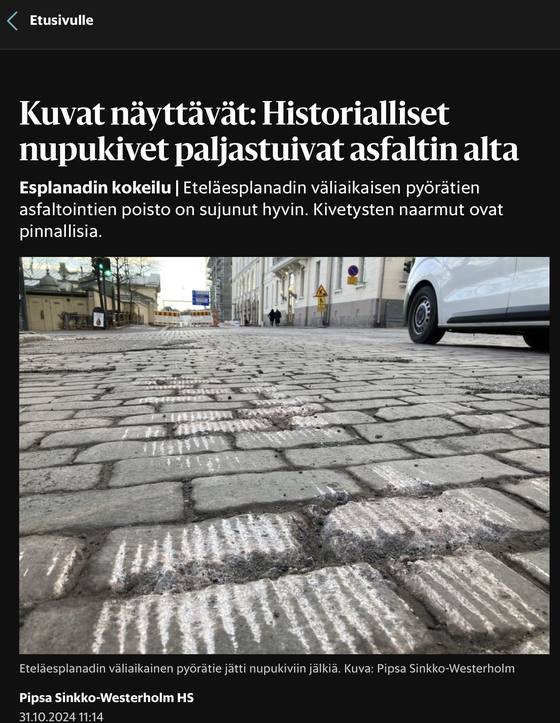
News: historic cobblestones revealed as the asphalt is removed again
Demolition
The asphalt comes up again — conflict surfaces too late.

Democracy isn’t just about choice. It’s about rethinking your choice.

8The loop
01Propose 02Compare 03Deliberate 04Converge see consequences, change your mind in public

“The value of participation is not in deciding what most people want, but in discovering what we could want, together.

CoPlanAI — working principle

In Helsinki, first instincts — bike lanes, everywhere — evolved once people could compare consequences side by side. That evolution is the democratic act.

9Ethics

The Hippocratic Oath of working with AI.

Bringing AI into a planning organisation is not a tooling decision — it transforms the institution. So the institution owes itself an explicit ethic. Ours, in four commitments.

01

Augment judgment — never automate it away

Agents cluster, theme and summarise. Officials review the synthesis instead of compiling it — the clerical work goes, the judgment stays.

02

Preserve the right to know and to change

Every participant can see consequences and revise their choice in public — the loop the whole method is built on.

03

Make the model’s biases legible

Before asking anyone to trust its images, we show where the model leans — and let the room correct it.

04

Represent those who cannot be in the room

Children, future residents, ecosystems — voiced by tuned agents, never confused with the living public.

A working draft — we ask every partner organisation to rewrite it as their own.
10Repair

A reparative technology.

The deepest repair is to participation itself — which has a default participant (adult, articulate, free on a weekday evening) while everyone else is structurally absent. Our agents can be tuned to centre the people, and the species, planning routinely overlooks.
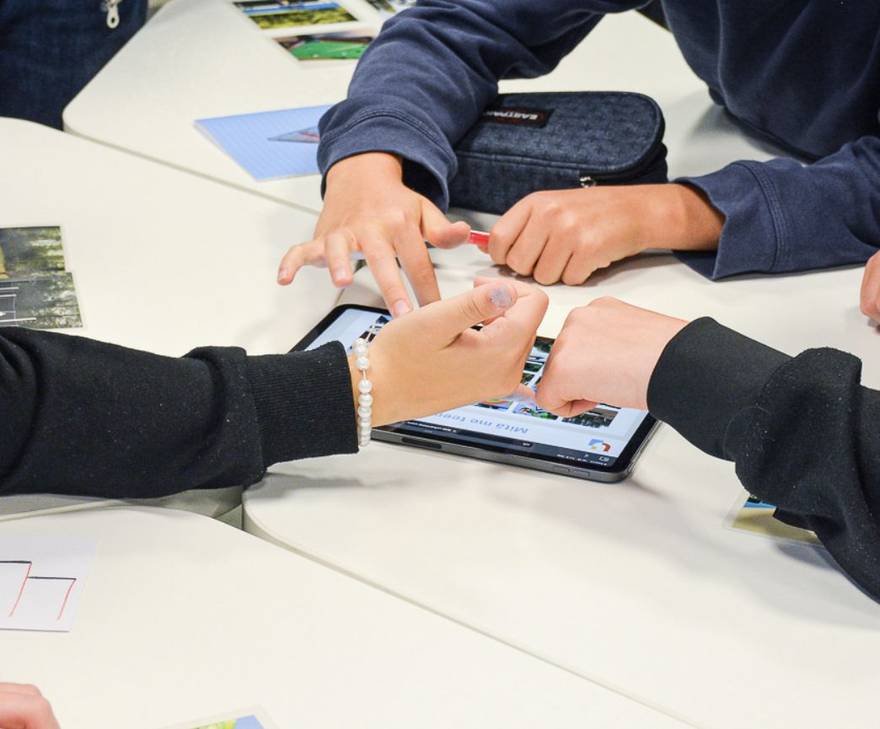
Children arranging printed site photos next to a tablet running CoPlanAI
Children · 6–14
From commentators to placemakers

A child-specific participatory AI — with an Architects’ Council of Europe grant, piloted in Finnish schools and at Milan Digital Week.
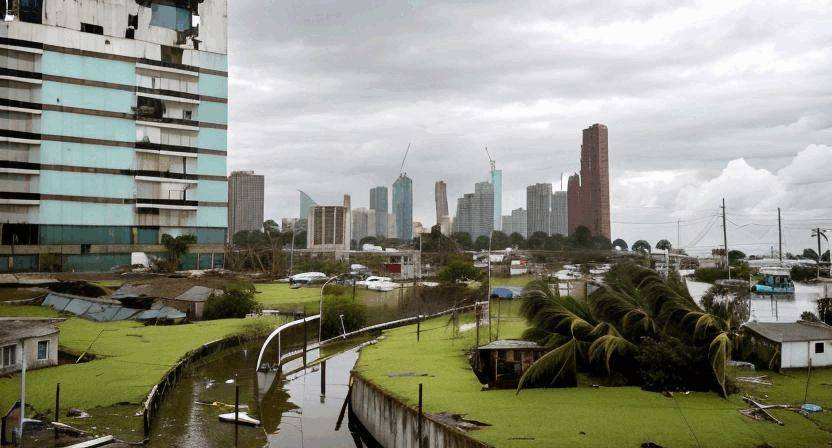
AI climate-adaptation scenario of the Panama City waterfront
Youth · Climate
Exploring climate futures with the young

With UNDP Accelerator Labs Panama, students turned photos of their own waterfront into climate-adaptation scenarios they could own.
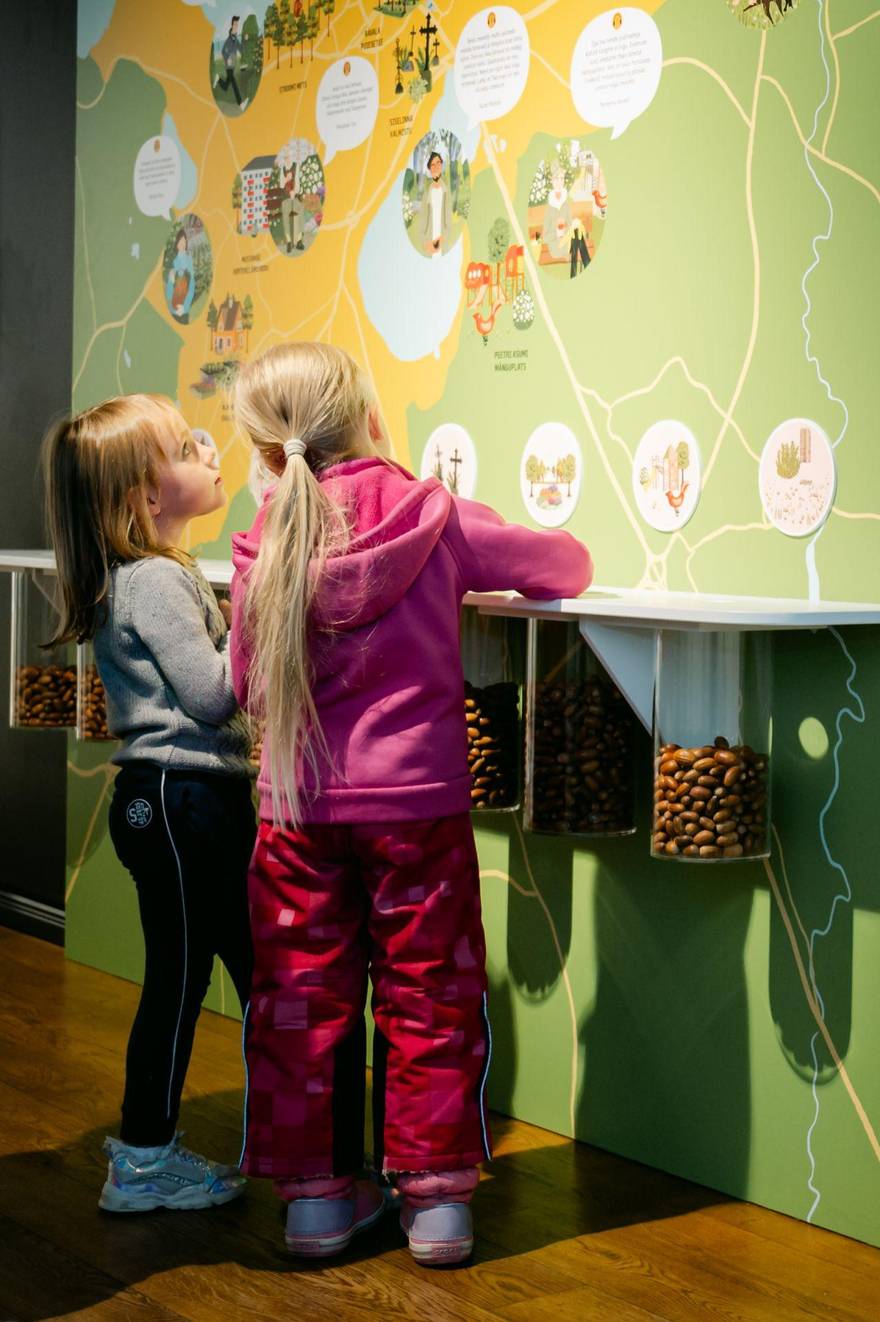
Children at the BiodiverseCity exhibit, Estonian Museum of Natural History, Tallinn
More-than-human
Parameters beyond people

At BiodiverseCity? (Estonian Museum of Natural History, Tallinn) a tuned model let children reimagine communal areas as wilder habitats.

11Regulation & quality

Imagination, evaluated against policy.

The newest layer answers the question every authority asks next: fine, but is it compliant — and is it good? Agents score co-designed scenarios against EU policy, local design guides and municipal strategy, while professionals keep the final word.
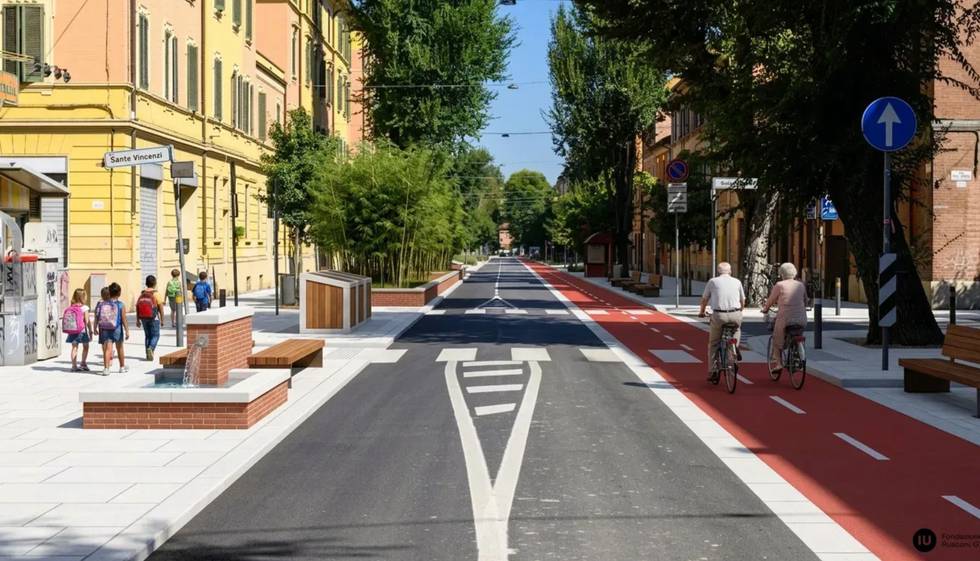
Bologna street scenario co-designed with new greenery and a red cycle lane
Bologna Verde · citizen scenario, 2026

The scenario, assessed

A generated image is easy to love and easy to dismiss. Switch to Evaluated to see the assessment that makes it usable in planning.

+ social seating+ canopy & microclimate+ permeable surface− open pavement
EU policy alignment82
Bologna design guide74
Municipal strategy90
Illustrative scores

Bologna’s own catalogue of permeable, vegetal and mineral materials becomes the evaluation criteria — checked while imagination is still cheap to change. Also in evaluation: Vienna Supergrätzl and Dubai Municipality. · Illustrative scoring.

12Evidence

Already in the field — and it travels.
90+
documented projects
28
countries
2021
running since
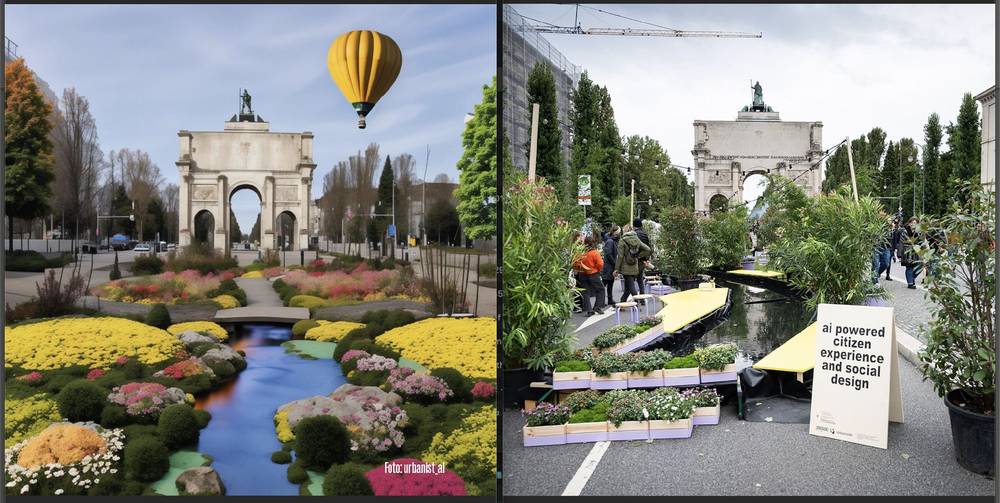
Munich Siegestor reimagined as a garden landscape
Munich · Zamanand Festival
Trust as infrastructure

3,000+ ideas, ~300 votes reimagining the space around the Siegestor.
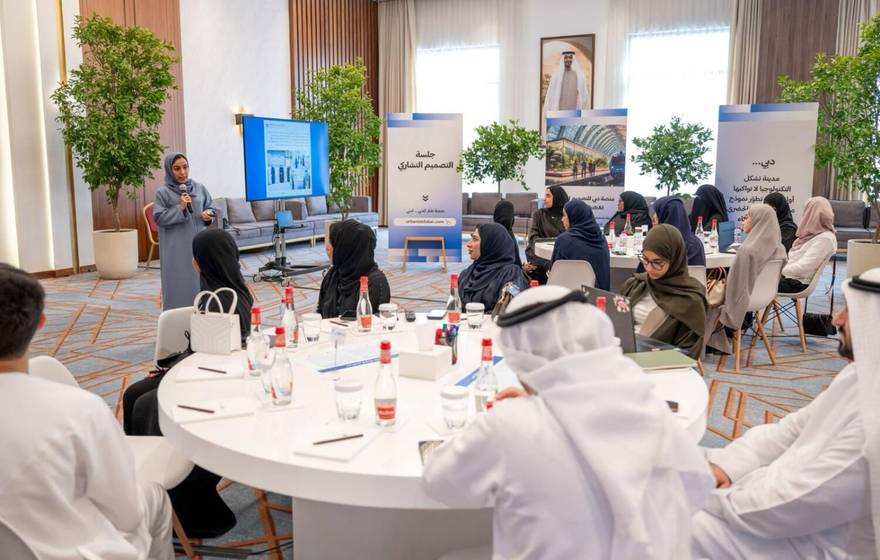
Dubai Municipality residents co-designing around a round table
Dubai Municipality · UAE
Residents design a future park

An interactive play area and shaded cycling track — with planning law in the loop.
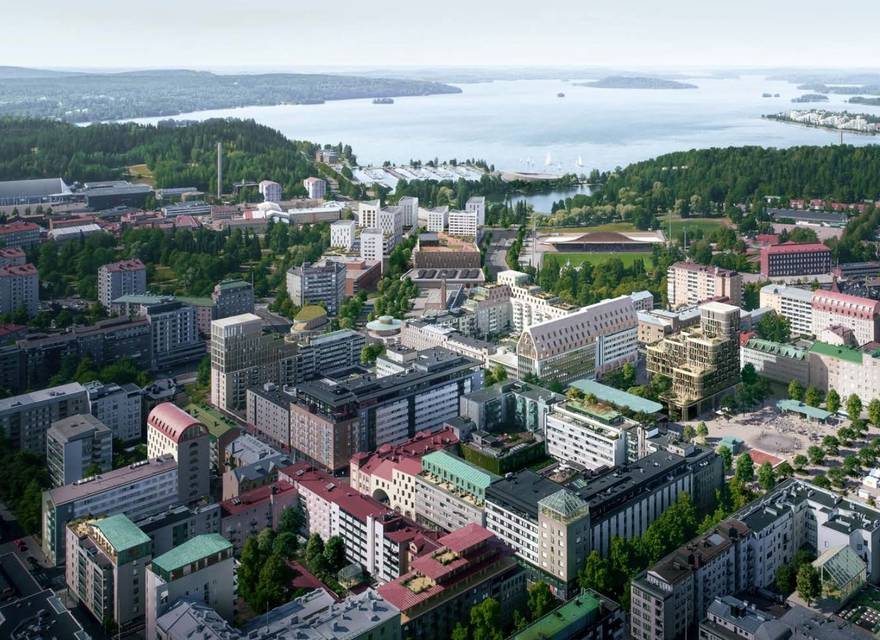
Aerial view of Lahti city centre by the lake
Lahti · Finland
A city-centre vision, co-planned

Collective imagination feeding directly into the municipal strategy document.
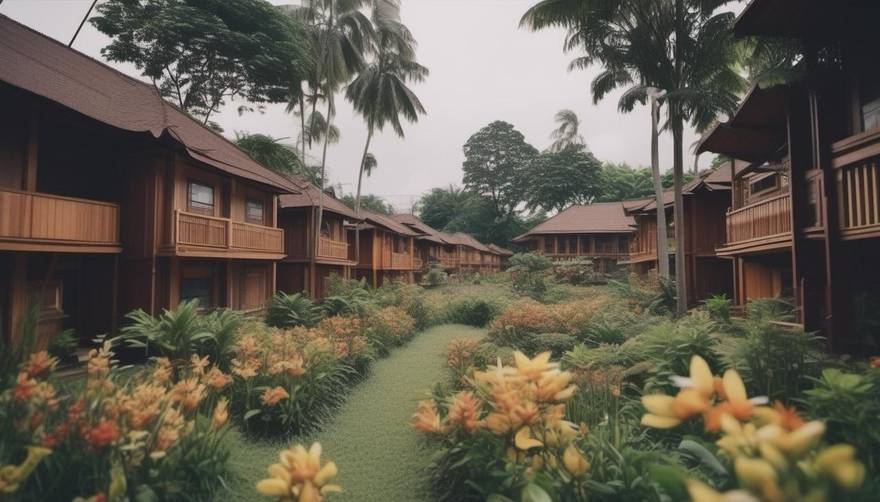
AI scenario of a green low-rise neighbourhood for Nusantara, Indonesia
Nusantara · Indonesia
Co-designing a capital city

Participatory AI at the most consequential scale: a city that does not exist yet.
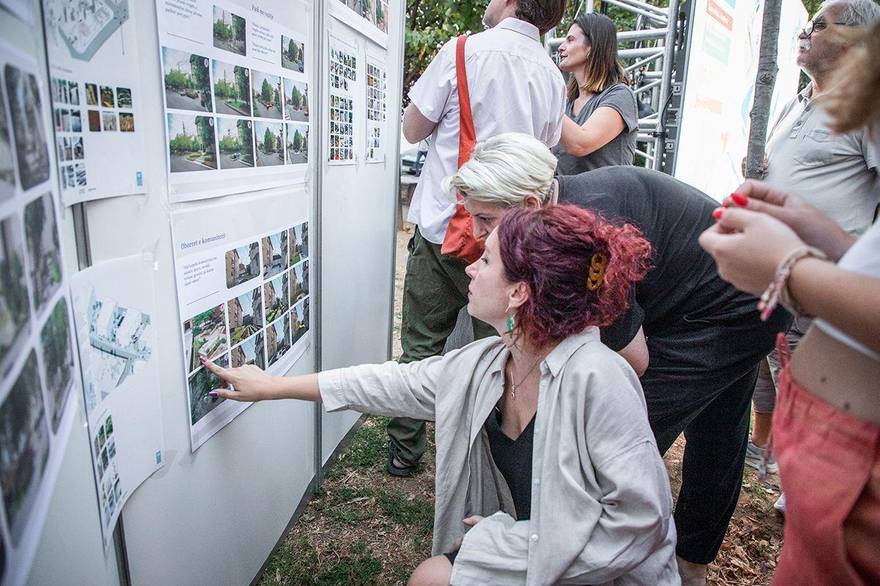
Residents reviewing design boards at the Blloku workshop in Pristina
Pristina · Kosovo
Regenerating Blloku, together

A UNDP-led regeneration with the mayor’s office at the table.
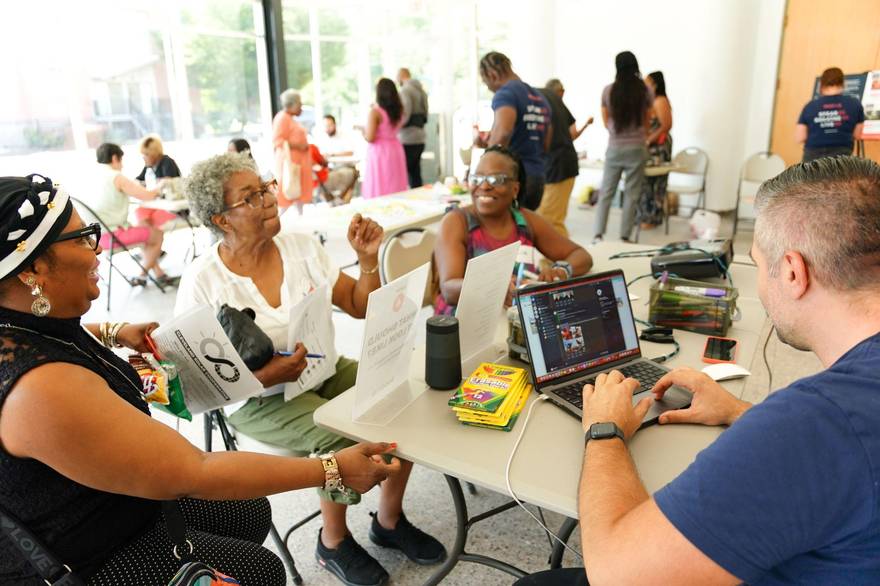
Open-house participants working with tablets in East Cleveland
East Cleveland · USA
Reimagining vacant spaces

Seventh Hill’s Connect East Cleveland — community-led co-design, from the first photograph.

13The console

Behind the room, you stay in control.

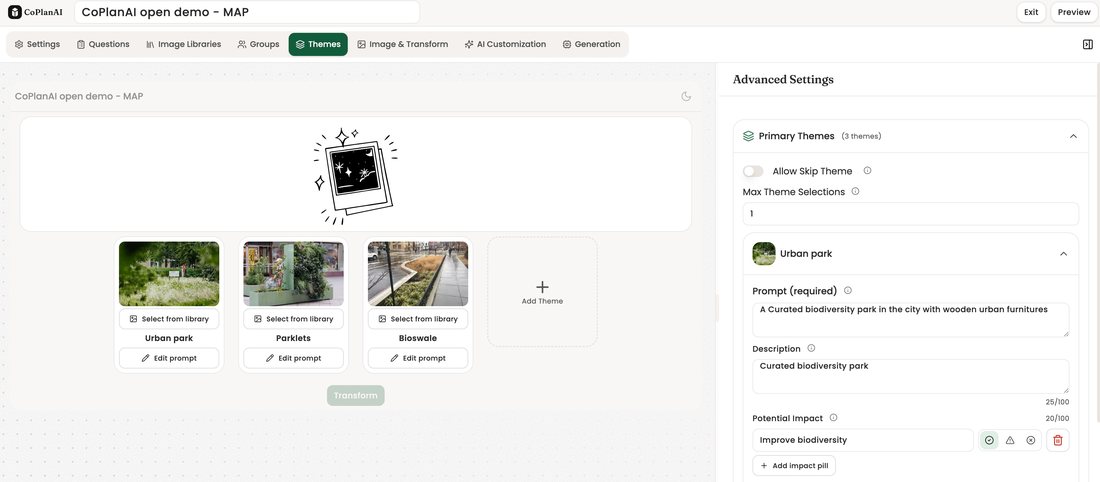
Participants see no software to learn — just a photo and a question. Organisers configure the session before it starts, then watch and steer it as it runs.
console.coplanai.com
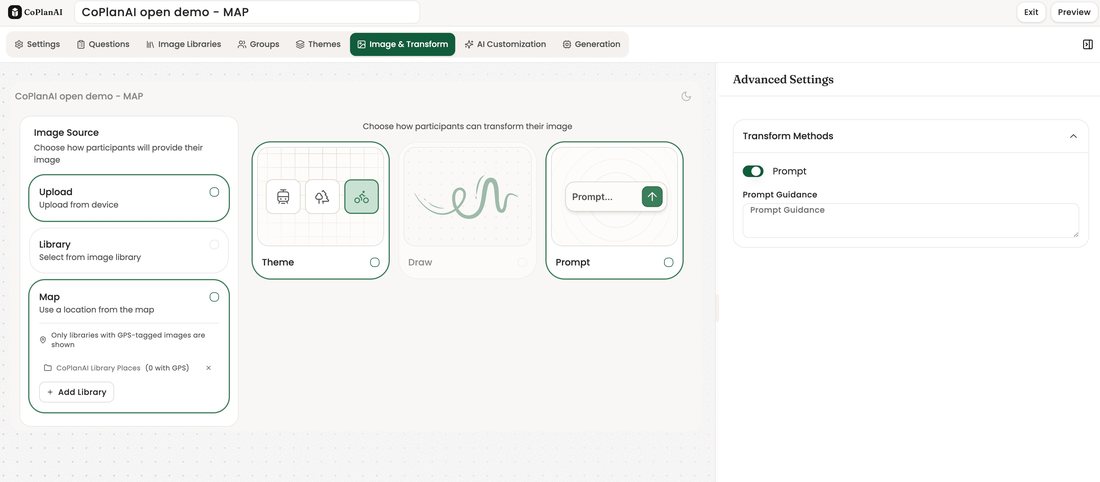
CoPlanAI console — source and transform CoPlanAI console — set the themes CoPlanAI console — steer it live
Source & transform

Pick where images come from — upload, library or map — and how participants reshape them: theme, draw or prompt.

14The path

From first call to a mandate — in about two weeks.

Every engagement follows the same arc, built around your institution. You bring one real question, a place or a plan, and the people. We handle configuration, training, facilitation and the technical translation.

Week 1
Framing
you + CoPlanAI
Week 1
Capacity building
you + CoPlanAI
Week 2
Workshop set-up
you + CoPlanAI
Workshop days
Workshops
in person + online
Live
Supervision
accountable humans
On close
Mandate & handover
the office owns it
● Day 1 · first call≈ 2 weeks · a documented mandate ●

What the office keeps: a documented mandate, a configured, re-runnable platform, and a trained team — not a report that ages on a shelf.

Where this goes

Citizens propose.
The city responds.

Cities are asked to deliver the future; CoPlanAI gives them, and the people they serve, the instrument to imagine it in public — and the evidence to act on it. Start with one real question, in one office, and build from there.